A balance statement, often referred to as a balance sheet, is a vital financial document that summarizes a company’s assets, liabilities, and shareholders’ equity at a specific moment. This snapshot helps you evaluate a company’s financial health and stability. Comprehending its components is fundamental for appraising investment opportunities and creditworthiness. As you explore further, you’ll uncover how to interpret these details effectively and recognize common misconceptions surrounding balance statements.
Key Takeaways
- A balance statement provides a snapshot of a company’s financial position, detailing assets, liabilities, and shareholders’ equity at a specific time.
- It adheres to the accounting equation: Assets = Liabilities + Shareholders’ Equity, ensuring total assets equal total liabilities and equity.
- An example includes current assets like cash and accounts receivable, and non-current assets like property, alongside current and long-term liabilities.
- Balance statements assist stakeholders in evaluating a company’s financial health, creditworthiness, and ability to meet obligations.
- Regular analysis of balance statements helps identify trends, assess liquidity, and inform strategic planning and resource allocation.
What Is a Balance Statement?

A balance statement, often referred to as a balance sheet, is a crucial financial document that provides a snapshot of a company’s financial position at a specific moment. It summarizes a company’s assets, liabilities, and shareholders’ equity, adhering to the accounting equation: Assets = Liabilities + Shareholders’ Equity.
This equation guarantees that the total assets are always equal to the total liabilities and equity, reflecting a balanced financial state.
A balance statement example typically includes current assets such as cash and accounts receivable, along with current liabilities like accounts payable. Shareholders’ equity reflects retained earnings and other investments.
Key Components of a Balance Statement
Grasping the key components of a balance statement is fundamental for comprehending its role in financial reporting. A balance statement includes three main elements: assets, liabilities, and shareholders’ equity.
Assets are divided into current and non-current categories, where current assets, like cash and accounts receivable, are expected to convert to cash within a year. Liabilities likewise fall into current and non-current sections, indicating what the company owes in the short and long term.
Shareholders’ equity represents the net worth of the business, calculated by subtracting total liabilities from total assets, and includes retained earnings and additional paid-in capital. Grasping these components is vital during financial statement preparation, as they follow the accounting equation: Assets = Liabilities + Shareholders’ Equity.
This equation guarantees the balance sheet remains balanced, accurately reflecting the company’s financial health at a specific moment in time.
Understanding Assets and Liabilities

Comprehending assets and liabilities is crucial for evaluating a company’s financial position. Assets are divided into current assets, like cash and inventory, which can be converted into cash within a year, and non-current assets, such as property and intangible assets, held for longer periods.
Conversely, liabilities are likewise categorized; current liabilities, including accounts payable and wages payable, are due within a year, whereas non-current liabilities, like long-term loans, are payable after one year.
Understanding financial statements involves recognizing the relationship between assets and liabilities, as this determines a company’s net worth or shareholders’ equity. You calculate this by subtracting total liabilities from total assets.
A balance sheet must adhere to the accounting equation: Assets = Liabilities + Shareholders’ Equity, indicating that every asset is financed either by debt or equity.
Grasping these distinctions helps you assess liquidity and financial risk, aiding in informed investment or lending decisions.
Importance of a Balance Statement
Comprehending the importance of a balance statement is vital for anyone involved in financial decision-making. A balance sheet offers a clear snapshot of a company’s financial position, detailing assets, liabilities, and shareholders’ equity at a specific moment. This information allows stakeholders to assess financial health and stability accurately.
The balance statement adheres to the accounting equation (Assets = Liabilities + Equity), ensuring that all data is represented correctly, fundamental for maintaining financial integrity.
Investors and lenders rely on balance statements to evaluate a company’s ability to meet short-term obligations, impacting their investment decisions and creditworthiness assessments. Furthermore, the balance sheet aids in calculating key financial ratios, such as the debt ratio and current ratio, which provide insights into liquidity and leverage.
Regularly reviewing balance statements helps businesses track growth trends, informing strategic planning and resource allocation for future financial stability, highlighting the importance of a balance statement in effective financial management.
How to Read a Balance Statement

To read a balance statement effectively, you should start by comprehending its key components: assets, liabilities, and shareholders’ equity.
Each section provides essential information about what a company owns, owes, and its overall worth, helping you grasp its financial position.
Furthermore, analyzing financial ratios and interpreting key figures can offer deeper insights into the company’s performance and stability.
Understanding Balance Sheet Components
A balance sheet is a crucial financial statement that provides a snapshot of a company’s financial position at a specific point in time. It consists of three main balance sheet components: assets, liabilities, and shareholders’ equity, adhering to the accounting equation: Assets = Liabilities + Shareholders’ Equity.
| Component | Description |
|---|---|
| Assets | Current (cash, accounts receivable) & Non-current (property, equipment) |
| Liabilities | Current (accounts payable, short-term debt) & Long-term (bonds payable, loans) |
| Shareholders’ Equity | Net worth, including common stock and retained earnings |
Analyzing Financial Ratios
Comprehending how to analyze financial ratios derived from a balance sheet is vital for evaluating a company’s financial health.
Key ratios like the current ratio, calculated by dividing current assets by current liabilities, assess liquidity, with a ratio above 1 indicating sufficient assets to cover obligations.
The debt-to-equity ratio reveals leverage and financial risk; lower values typically suggest less risk.
Return on equity (ROE), which divides net income by shareholder equity, measures profitability relative to equity, where higher values indicate efficient equity use.
The quick ratio, excluding inventory, offers a stricter liquidity measure.
Interpreting Key Figures
Grasping how to interpret key figures on a balance statement is essential for evaluating a company’s financial position. When you learn how to read financial statements, focus on the three main sections: assets, liabilities, and shareholders’ equity.
- Current assets vs. non-current assets: Understand the difference between short-term and long-term holdings.
- Current liabilities vs. non-current liabilities: Know which debts are due soon and which are long-term obligations.
- Shareholders’ equity: Recognize this as the company’s net worth after liabilities are deducted.
These key figures provide insights into a company’s financial stability, liquidity, and capital structure.
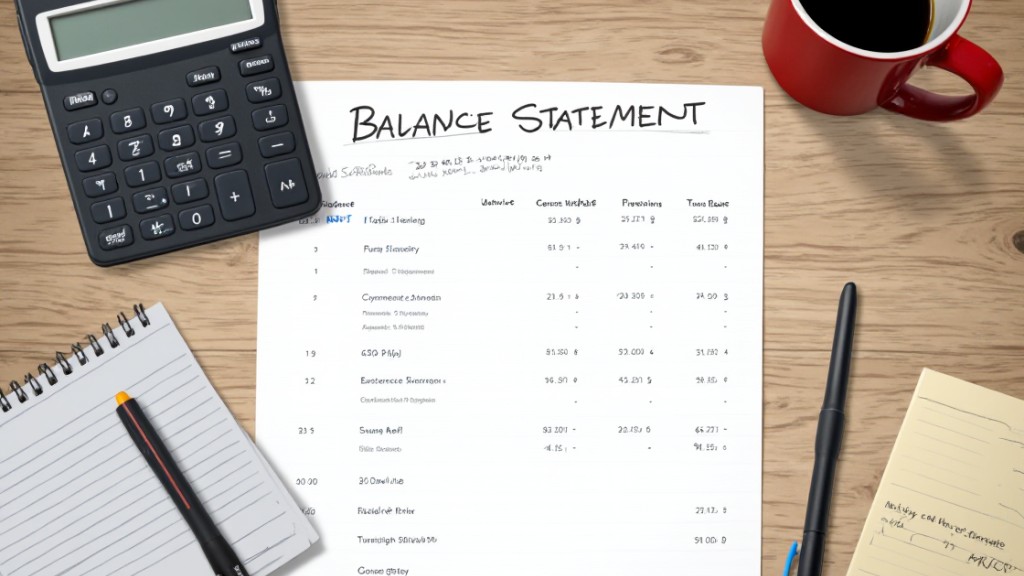
Example of a Balance Statement
Comprehending the layout of a balance statement is key to grasping a company’s financial health. A balance statement, as well known as a balance sheet, provides a snapshot of financial position at a specific date.
For instance, envision a balance statement showing total assets of $500,000, total liabilities of $300,000, and shareholders’ equity of $200,000. This adheres to the accounting equation: Assets = Liabilities + Equity.
You can see how the balance statement highlights a company’s liquidity and financial stability, as it details the resources available to meet obligations. Investors and creditors often analyze balance statements to evaluate a company’s ability to generate profits and manage debts.
Furthermore, when you compare a balance statement with previous periods, it can reveal trends, helping you identify growth patterns, financial risks, and areas needing management attention. Grasping these elements can greatly improve your insights into a company’s overall performance.
Common Misconceptions About Balance Statements

Even though many people rely on balance statements to gauge a company’s financial health, several misconceptions can cloud their grasp of these significant documents. Comprehending these common misconceptions about balance statements helps you interpret financial reports effectively.
- A balance sheet isn’t just a snapshot of current health; it likewise provides historical context.
- Balance sheets are dynamic documents, changing over time, not static reflections of a single moment.
- Not all assets and liabilities appear on the balance sheet, as some off-balance-sheet items can distort your perception.
It is vital to bear in mind that shareholder equity can sometimes be negative because of losses.
Furthermore, comparing balance sheets across multiple periods is fundamental for identifying trends.
Financial reports are used by investors, creditors, and analysts to make informed decisions, so grasping these misconceptions will improve your financial literacy and decision-making skills.
Frequently Asked Questions

What Is the Purpose of a Balance Statement?
The purpose of a balance statement is to provide a clear snapshot of a company’s financial position at a specific moment. It details assets, liabilities, and shareholders’ equity, allowing you to assess financial health.
By using this information, you can evaluate liquidity, solvency, and capital structure, which are vital for making informed investment or lending decisions.
Moreover, comparing balance statements over time helps identify trends that inform strategic planning and compliance efforts.
What Are the Three Most Important Things on a Balance Sheet?
The three most important components of a balance sheet are assets, liabilities, and shareholders’ equity.
Assets include everything of value the company owns, like cash and equipment.
Liabilities represent what the company owes, such as loans or accounts payable.
Shareholders’ equity reflects the owners’ interest in the firm, calculated by subtracting total liabilities from total assets.
Comprehending these elements helps you assess a company’s financial health and make informed decisions about its viability.
What Is the Importance of Balance Sheet With Example?
A balance sheet’s importance lies in its ability to provide a clear snapshot of your company’s financial health at a given moment.
For example, if you see total assets of $1 million and liabilities of $600,000, this indicates a solid financial position.
Analyzing these figures helps you make informed decisions about investments, manage debt, and track progress over time, ensuring your business remains attractive to potential lenders and investors.
How to Write a Balance Statement?
To write a balance statement, start by listing your assets, categorizing them into current and non-current.
Then, separate your liabilities into current and long-term.
Confirm you follow the accounting equation: Assets = Liabilities + Shareholder Equity.
Calculate shareholder equity by subtracting total liabilities from total assets.
Format the statement clearly, with assets on one side and liabilities plus equity on the other, to provide a straightforward financial snapshot for stakeholders.
Conclusion

In conclusion, a balance statement is crucial for comprehending a company’s financial health at a specific moment. By examining its assets, liabilities, and shareholders’ equity, you can assess liquidity and risk. This analysis aids investors and creditors in making informed decisions. Keep in mind that reading a balance statement requires attention to detail, as it reveals insights into a company’s operational efficiency. Familiarizing yourself with its components will improve your financial literacy and ability to evaluate business opportunities effectively.
Image via Google Gemini