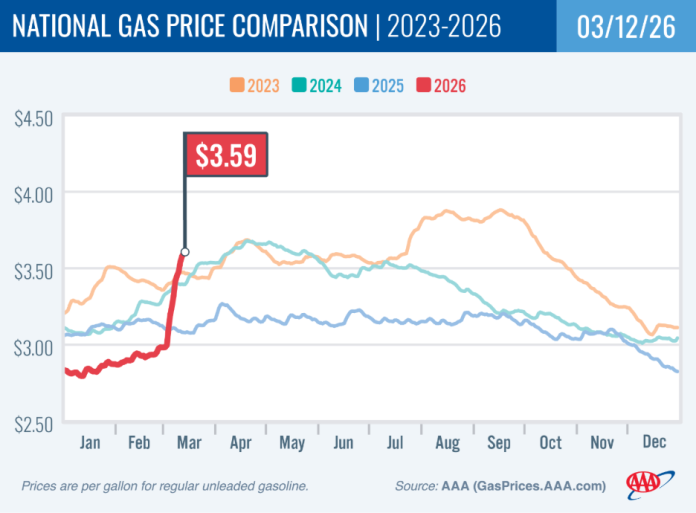
As Spring Break kicks off, small business owners are feeling the impact of rising gasoline prices, which have surged nearly 35 cents in just the past week. With current national averages sitting at $3.598 per gallon—similar to 2024 levels—businesses that rely on transportation are advised to evaluate their operational costs closely as demand for fuel increases.
The boost in gasoline prices correlates with the onset of warmer weather and heightened travel, both of which contribute to increased traffic on the roads. The Energy Information Administration (EIA) recently reported an uptick in gasoline demand from 8.29 million barrels per day to 9.24 million, which signals a significant jump in consumer activity. "The rise in demand each Spring Break serves as a reminder for small businesses to prepare for fluctuations in fuel costs," says a representative from AAA.
As crude oil prices have climbed above $100 per barrel multiple times recently, small business owners should be mindful of how these costs filter down to their daily operations. In a bid to alleviate some pressure on prices, the U.S. government announced a release of 172 million barrels of oil from strategic reserves over the next four months, part of a larger initiative by the International Energy Agency, which aims to release a total of 400 million barrels—its largest intervention to date.
With the rising fuel prices, businesses must consider how it affects their bottom line. For delivery-based services, transportation costs can take a significant toll. "Planning more efficient routes or adjusting delivery schedules could mitigate the impact of rising fuel costs," advises a logistics expert. Additionally, businesses that use farm-to-table models or other supply chains that rely on transportation may see a direct correlation between fuel prices and their expenses.
The EIA also reported a reduction in total domestic gasoline supply, which dropped from 253.1 million barrels to 249.5 million. However, production levels are optimistic, with output averaging 9.9 million barrels per day—an increase that could help stabilize prices in the long run.
Electric vehicle (EV) charging options are also evolving as a response to these price increases. The national average for public EV charging rose to 41 cents per kilowatt-hour, up by 2 cents from the previous week. As more businesses incorporate EVs into their fleets, they need to consider the fluctuating costs related to charging infrastructure. Comparisons in pricing indicate that, while some states experience high charging costs—like Hawaii at 51 cents—others, such as Kansas at 29 cents, could offer more affordable options for businesses.
Small business owners in urban areas may find it beneficial to adopt hybrid or electric vehicles, which could buffer them against rising gasoline prices in the future. However, the challenge remains in the initial investment for EVs and the necessarily available charging infrastructure.
Furthermore, local markets showcase dramatic divides in fuel pricing. For instance, California’s average gas price is $5.36—significantly higher than Kansas, where it sits at around $3.04. Understanding regional disparities can aid businesses in their logistical planning. If operations extend across state lines, budgeting for varying gas prices becomes essential.
For business owners looking to navigate these challenges effectively, resources like the AAA TripTik Travel planner can assist in finding current gas and EV charging prices along their routes, providing a practical tool to optimize travel plans.
As consumers take to the roads for Spring Break, businesses must remain agile to adapt to the fluctuating economic landscape dictated by rising fuel costs. Evaluating operational processes and considering the balance between traditional and electric fuel sources could prove vital in sustaining profitability as demand shifts in the coming weeks.
For additional insights and real-time updates on gasoline prices, visit the original post here.
Image Via Gas Price