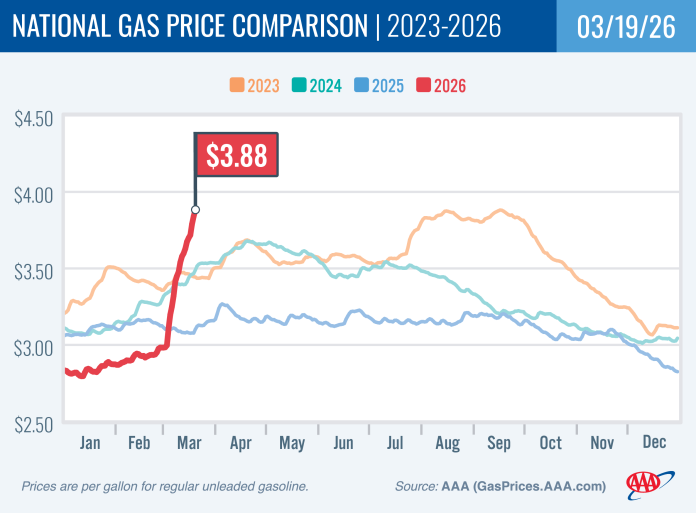
Gas prices are on the rise as spring approaches, reflecting seasonal demand and market dynamics. According to the latest data from the American Automobile Association (AAA), the national average for gas jumped by 28 cents over the past week, landing at $3.884 per gallon. With warmer weather encouraging travel, small businesses, particularly those reliant on vehicle use, may begin to feel the impact of these rising fuel costs.
The recent increase is notable compared to last month’s average of $2.929 per gallon and last year’s $3.102. For small business owners, it’s imperative to monitor these fluctuations not only for direct operating costs but also to anticipate how these impacts might ripple through customer spending and operational strategies.
Furthermore, the energy market faces additional complexities. The White House’s recent decision to release 172 million barrels of oil from strategic reserves, intended to ease pressure on prices, has yet to produce immediate effects. The price of crude oil remains elevated at $96.32 per barrel, which can make long-term planning difficult for businesses that rely on fuel for transportation and delivery.
While gasoline demand experienced a decrease—from 9.24 million barrels per day to 8.72 million—domestic gasoline supply also dropped from 249.5 million barrels to 244.0 million. The reduced gasoline production, averaging 9.4 million barrels per day last week, raises concerns about inventory levels, posing challenges for small businesses that need reliable fuel access.
The marketplace is already responding to this pressure. States with the highest gasoline prices include California at $5.61, Washington at $5.14, and Hawaii at $5.07, while the lowest prices can be found in Oklahoma and Kansas, both at $3.24. These regional disparities could impact retailers and service providers differently, depending on their location and customer base.
For small businesses, especially those in delivery or transportation sectors, managing fuel expenses becomes a critical component of operational efficiency. As prices climb, business owners might consider strategies like optimizing routes, consolidating deliveries, or investing in fuel-efficient vehicles. The financial model of businesses with heavy fuel dependence could face significant strain, emphasizing the need for proactive financial planning.
Electric vehicles (EVs) also present an alternative, given the steady average price of 41 cents per kilowatt-hour at public charging stations. As more businesses explore the sustainability of EVs, understanding the costs associated with electric charging across various states becomes essential. The states with the highest public charging costs include West Virginia (53 cents) and Hawaii (51 cents), while Kansas offers a lower rate at 29 cents per kilowatt-hour. Companies looking to transition to electric fleets should consider both the initial investment and the long-term savings through reduced fuel costs.
In this volatile market environment, small business owners can utilize tools like the AAA TripTik Travel Planner to keep abreast of current gas and electric charging prices along their routes. Staying informed can empower businesses to make strategic decisions that enhance cost-efficiency and mitigate the impact of rising fuel prices.
As spring arrives with its promise of renewed travel, the rising cost of fuel poses both challenges and opportunities for small businesses. By remaining vigilant and adapting strategies accordingly, owners can navigate these changes and potentially safeguard their operations.
For further information, refer to the original post here.
Image Via Gas Price