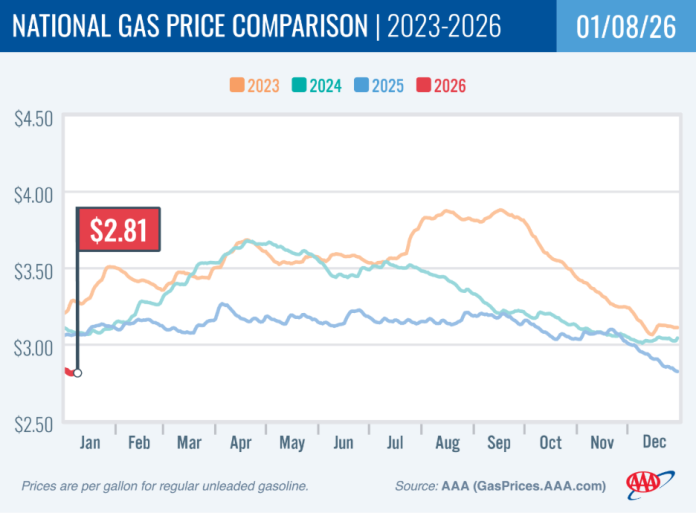
The start of 2026 brings promising news for small business owners: the national average for a gallon of regular gas has reached its lowest level in nearly five years at $2.81. This significant decline could have lasting implications for operating costs and consumer behavior, especially for businesses relying heavily on transportation.
The latest figures from the Energy Information Administration (EIA) reveal that gas prices have seen a notable drop. Just a week ago, the average was slightly higher at $2.83, and only a month ago, it stood at $2.95. Comparatively, last year around this time, the average was $3.069. This shift signals a broader trend that could benefit businesses by lowering fuel expenses—an essential consideration for any company that requires transportation for deliveries, commuting, or logistics.
Industry experts highlight that low gas prices often correlate with increased consumer spending. “Lower fuel costs can provide consumers with extra discretionary income, which they may choose to spend on goods and services,” said a representative from the American Automobile Association (AAA). This increased spending power could translate into higher sales for retail operations and service-oriented businesses.
Maintaining stable crude oil prices has also played a role in the current situation. As of the start of the year, the crude oil market remains steady without any significant production changes anticipated from OPEC+, the coalition of oil-exporting countries. With a robust global oil supply, small businesses could benefit from sustained lower prices if these dynamics persist.
However, it’s important for small business owners to consider the broader engine driving these prices. Gasoline demand saw a decrease last week, dropping from 8.56 million barrels per day to 8.17 million. Concurrently, domestic gasoline supply increased to 242 million barrels, indicating a potential shift in consumer habits or market dynamics that could affect these low prices in the future.
Navigating the ever-evolving energy landscape also requires vigilance concerning electric vehicle (EV) trends. Currently, the average cost of electricity at public EV charging stations is sitting at 38 cents per kilowatt hour. For businesses considering transitioning to electric fleets, understanding the charging costs in various states can influence the decision-making process. For instance, Kansas offers the most competitive prices at 26 cents per kilowatt hour, while states like West Virginia and Alaska are significantly higher.
One notable advantage of lower gas prices is their effect on regional disparities. According to the latest data, states like Oklahoma and Arkansas are some of the least expensive markets for gasoline, priced at $2.25 and $2.37, respectively. Conversely, Hawaii and California continue to face high gas prices at $4.42 and $4.23 per gallon. Small business owners operating in higher-cost states might keep a close eye on these figures as price variations could affect competitive strategies and pricing models.
While the decline in gas prices signals opportunities, it is essential for businesses to also stay aware of potential challenges. The EIA noted a decrease in gasoline production recently, averaging 9 million barrels per day, which could potentially lead to shortages or price fluctuations if demand rebounds unexpectedly. Moreover, with U.S. crude oil inventories running around 3% below the five-year average, any geopolitical shifts or changes in supply dynamics could quickly shift the landscape.
In conclusion, small business owners should take advantage of the current low gas prices while being mindful of the underlying market dynamics and possible shifts in consumer behavior. By carefully assessing these factors, businesses can adapt their strategies to optimize their operations and respond effectively to changing conditions. For ongoing updates on gas prices and to find current rates along travel routes, the AAA TripTik Travel planner is a useful resource.
For more details, visit the original post here.
Image Via Gas Price