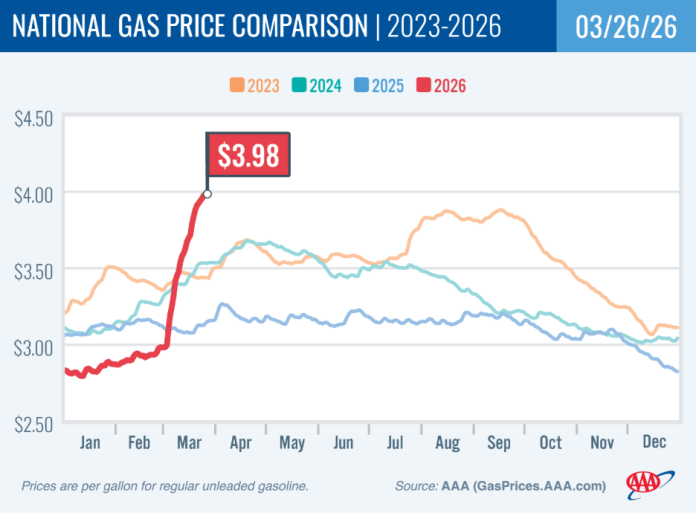
The United States is grappling with a significant surge in gasoline prices, reflecting a broader trend that small business owners should be keenly aware of. As of March 26, 2026, the national average for a gallon of regular gasoline has climbed to $3.98, a sharp increase of one dollar in just a month. This jump is not only concerning for individual drivers but carries implications for small enterprises that rely heavily on fuel for operations.
The latest data from the Energy Information Administration (EIA) reveals that gasoline demand has escalated from 8.72 million barrels per day to 8.92 million in the past week. At the same time, the total domestic supply has dwindled from 244 million barrels to 241.4 million. These dynamics are further compounded by rising crude oil prices, which remain elevated due to the ongoing conflict in Iran, pressuring the market further.
For small business owners, this spike in fuel prices translates to immediate, tangible consequences. Higher fuel costs can lead to increased operational expenses, especially for businesses that involve transportation, such as delivery services and logistics firms. Small business owners must evaluate how these rising costs will affect pricing strategies and profit margins.
The effects of this fuel price increase ripple through the economy. It could result in higher costs for goods and services, as transportation becomes more expensive. “Rising gasoline prices have a cascading effect on various sectors, particularly for small businesses already operating on tight margins,” notes an industry expert. “Owners need to plan ahead, adjusting budgets and possibly reconsidering pricing structures to maintain profitability.”
The pattern is not without precedent. Similar hikes have occurred in previous years, often correlating with rising demand duringholiday and vacation seasons. This March spike comes just as the spring break period intensifies, increasing the number of vehicles on the road and, consequently, the draw on fuel supply.
For business owners, understanding regional differences in fuel pricing can also inform decisions. For example, states like California, where prices are highest at around $5.84 per gallon, contrast sharply with Oklahoma, where consumers pay just $3.25. Such discrepancies can be critical for businesses operating across state lines, influencing logistics and supply chain management.
Additionally, while gasoline prices are soaring, electric vehicle (EV) market dynamics also play a role. The cost of electricity at public charging stations has remained stable at 41 cents per kilowatt-hour, presenting an alternative for businesses considering EVs. Transitioning to electric vehicles could lead to long-term savings on fuel costs, though initial investments may pose a hurdle.
Small business owners also need to stay informed about their local energy landscape. For instance, some states offer lower rates for EV charging, which might entice businesses to electrify their fleets. Kansas, for instance, boasts the least expensive public charging rates at 29 cents, offering a stark comparison to states with elevated fees.
Navigating these fluctuations is essential for maintaining operational health. Leveraging tools like the AAA TripTik Travel planner can assist businesses in finding the best fuel prices along delivery routes, which can lead to cost savings.
As businesses adapt to an increasingly volatile economic landscape marked by rising fuel prices and changing energy costs, strategic planning will be crucial. Owners must weigh their options, perhaps reassessing supplier agreements, delivery schedules, or even customer pricing to better align with current market conditions.
With the national average for gasoline expected to reach $4 per gallon soon—a milestone not seen since August 2022—small business owners must take proactive steps to mitigate impacts. Keeping a watchful eye on market trends will enable informed decisions in this challenging environment. For more details, check out the full report here.
Image Via Gas Price