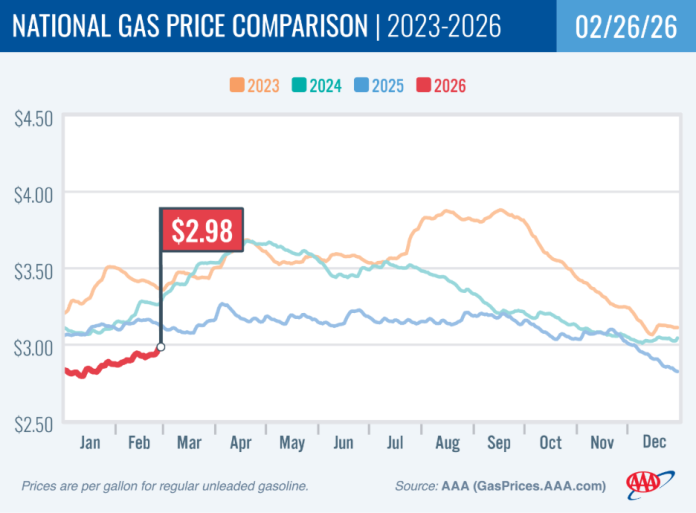
Spring may still be a few weeks away, but the seasonal rise in gas prices is already underway, presenting both challenges and opportunities for small business owners across the country. This week, the national average for a gallon of regular gasoline climbed over 5 cents to $2.98, a noticeable shift that signals the onset of summer-blend gasoline production. These blends, while necessary for environmental reasons, come with costly additives that can drive up prices, impacting smaller businesses dependent on reliable and affordable fuel.
As the road trip season approaches, gas demand is expected to spike, mainly influenced by spring break travel. This uptick in demand could complicate the financial outlook for businesses, particularly those in transportation, delivery, and logistics. According to the AAA, gasoline production has shown a decline, averaging 9.2 million barrels per day, which could further pressurize fuel prices.
Key takeaways from the latest report indicate that while prices have risen compared to recent weeks—up from $2.93 a week ago and $2.88 a month prior—they remain lower than last year’s average of $3.13. Despite this trend, small businesses should prepare for potential operational challenges, as fuel costs are an essential component of their overall expenses.
“Small businesses need to be particularly vigilant as fuel prices begin to rise,” said a spokesperson from the AAA. “Understanding these shifts can help business owners better anticipate costs and plan accordingly.”
Real-world implications of rising fuel costs are straightforward yet crucial. For businesses reliant on transportation, whether for deliveries or commuting employees, increased fuel prices can erode profit margins. Owners may need to explore strategies such as optimizing delivery routes or even switching to fuel-efficient vehicles to mitigate these rising costs.
The price of crude oil also plays a vital role. The latest data indicates a slight drop in West Texas Intermediate (WTI) crude to $65.42 per barrel. With U.S. crude oil inventories up by 16 million barrels from the previous week, this could offer a temporary stabilization in prices, although the overall trajectory leans toward an increase as the summer months approach.
In contrast to gasoline, electricity prices at public EV charging stations have remained stable at an average of 39 cents per kilowatt-hour. As more small businesses explore electric vehicles as a cost-effective and environmentally friendly option, understanding charging costs becomes increasingly critical. For those contemplating a switch to electric fleet vehicles, they should keep an eye on variable charging prices that can differ significantly by region.
State-specific statistics further illustrate the national landscape. For example, California leads with the highest gasoline prices at $4.63, followed by Hawaii and Washington. Conversely, states like Oklahoma and Mississippi offer lower prices, averaging $2.43 and $2.52, respectively. Such disparities can impact business decisions, particularly when considering expansion into different states or regions.
Moreover, as the demand for electric charging grows, small business owners might also want to consider the potential for offering charging stations as a service. Understanding local electric rates could allow them to tap into an emerging market while also attracting customers.
As the spring season unfolds, small business owners should remain alert to the dynamics of oil and gas markets. Monitoring rising prices, adapting operational strategies, and potentially diversifying vehicle fleets are crucial for maintaining efficiency and profitability.
To stay updated on the latest gasoline prices and trends, small business owners can utilize resources like the AAA TripTik Travel planner, which provides current gas and electric charging prices along various routes.
For additional information, see the original post here.
Image Via Gas Price