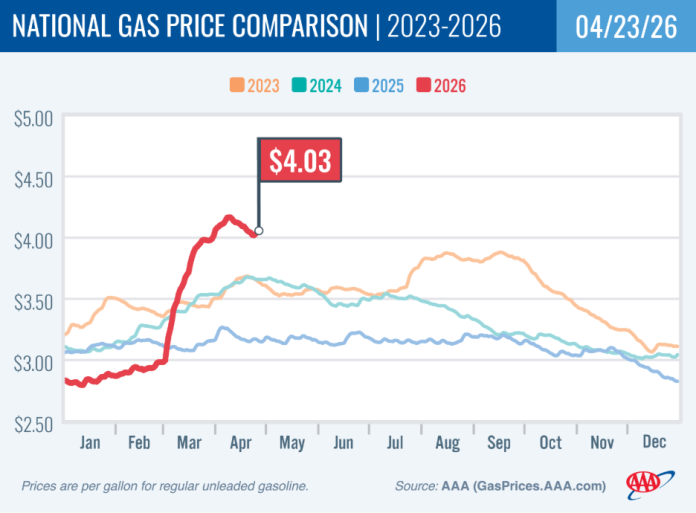
As gas prices begin to dip, small business owners may find a glimmer of hope in the national average dropping to $4.03 per gallon, reflecting a decrease of 6 cents since last week. With crude oil prices hovering below $100 per barrel, this modest relief arrives amidst broader market uncertainties, particularly concerning geopolitical instability in regions like the Strait of Hormuz.
The current price marks the highest point for this season since 2022, when prices registered at $4.11 on the same date. This slight decline can be particularly advantageous for small businesses that rely heavily on fuel for transportation and operations. For instance, delivery services, contractors, and fleet operators could see a slight easing in operational costs, fostering improved cash flow amid the challenging economic climate.
Gasoline demand also saw a minor decline last week, dipping to 9.05 million barrels per day from 9.08 million. This trend, coupled with decreased domestic gasoline supply, could further influence price dynamics in the near future. Small business owners should be aware that while prices are currently lower, they need to remain vigilant and proactive, as fluctuations in oil prices can alter operating costs.
The Energy Information Administration (EIA) reported that total gasoline supply fell from 232.9 million barrels to 228.4 million barrels. In contrast, gasoline production experienced a positive surge, averaging 10.1 million barrels daily. This could provide a buffer for prices if demand remains steady, presenting an opportunity for small business owners to consider adjusting their fuel procurement strategies accordingly.
The oil market itself is layered with complexity. On Wednesday, West Texas Intermediate (WTI) crude settled at $92.96 per barrel, after a significant rise of $3.29. U.S. crude oil inventories have climbed to about 465.7 million barrels, slightly above the five-year average for this time of year. For small business owners, these inventory levels signify some resilience in the market, but they should prepare for potential volatility based on external influences.
Switching gears, the transition to electric vehicles is also gaining momentum. Recently, the average cost of charging at public electric vehicle (EV) stations fell to 40 cents per kilowatt hour, down by one cent over the past week. This trend could be appealing to small businesses considering a switch to electric fleets as a long-term cost-saving measure. However, the costs associated with EV charging can vary significantly by location.
In terms of state-specific adjustments, the cost of gasoline varies widely across the country. California stands as the most expensive market at $5.84 per gallon, with other high-cost areas including Hawaii ($5.65) and Washington ($5.39). Conversely, states like Oklahoma ($3.40) and Kansas ($3.47) show much lower prices. For small business owners with geographic flexibility, choosing operations in lower-cost areas could improve profit margins.
When considering public EV charging costs, states such as West Virginia (53 cents) and Hawaii (51 cents) lead in expenses. In contrast, states like Kansas (25 cents) and Maryland (30 cents) offer a more economical charging experience. For businesses eyeing long-term sustainability and cost efficiency, these regional differences highlight the need for strategic planning regarding vehicle investments.
As fuel prices continue to fluctuate, small business owners may benefit from leveraging resources like the AAA TripTik Travel planner to identify the best current gas and electric charging prices along their routes. Such tools can assist them in making informed decisions to optimize transport and operational costs.
Navigating the changing landscape of fuel prices, small business owners must remain vigilant about market trends and external factors influencing prices. By staying informed and adaptable, they can better position their businesses for sustained growth amid economic fluctuations.
For further details on current gas and electric charging prices, visit the original post from AAA here.
Image Via Gas Price