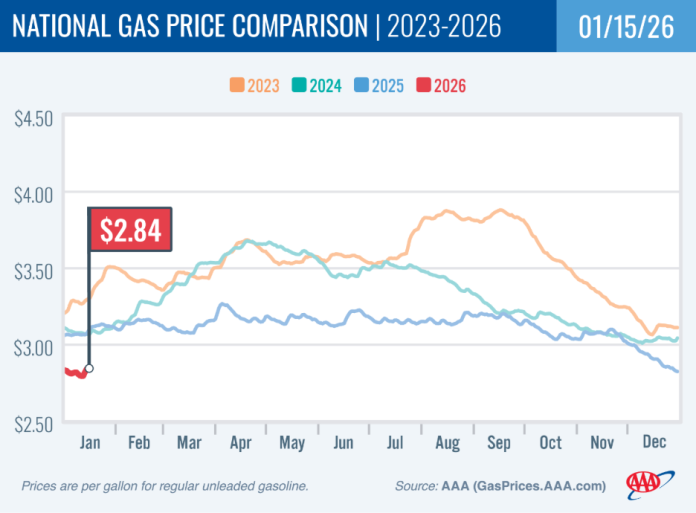
As gas prices continue to trend modestly upward, small business owners across the country are watching closely. The national average for a gallon of regular gasoline has increased by a couple of cents this week, now standing at $2.84. This shows a slight rise from $2.81 last week but remains significantly lower than the $3.08 average recorded during the same time last year. With January typically witnessing lower gas prices due to seasonal demand and the availability of winter blend gasoline, now may be an opportune moment for business owners to evaluate their fuel-related expenses and adjust their operational strategies accordingly.
The latest data from the Energy Information Administration (EIA) reports an increase in gasoline demand, climbing from 8.17 million barrels per day to 8.30 million. Moreover, domestic gasoline supply has surged from 242 million barrels to 251 million. Increased gasoline production, which averaged 9.0 million barrels per day, augurs well for maintaining supply levels. This could provide some stability for small businesses relying on transportation or logistics, making it easier for them to plan routes and budgets.
However, the potential for future price hikes looms, largely due to ongoing geopolitical tensions, particularly concerning Iran—a major player in the oil market and a member of OPEC. Any disruption in Iran’s oil production could ripple through global markets and affect domestic prices. For small business owners, this means that while current prices are favorable, it’s vital to stay agile and prepared for possible fluctuations.
“While today’s prices are lower than last year’s, we must remain vigilant of international developments that could affect our bottom line,” explains Andrew Peters, a small business consultant specializing in operational efficiency.
Moreover, the dynamics within the oil market indicate that crude oil prices are also on the rise, with West Texas Intermediate (WTI) closing at $62.02 per barrel. This increase, paired with a significant rise in crude oil inventories—up by 3.4 million barrels from last week—should prompt small business owners to keep a close eye on their fuel budgets. Being proactive in examining fuel usage and exploring ways to minimize costs can yield substantial long-term savings.
As electric vehicles (EVs) gain traction, it’s also essential to consider the costs for small businesses transitioning to or implementing electric solutions. Currently, the national average cost for electricity at public EV charging stations remains steady at 38 cents per kilowatt-hour. For small business owners contemplating the switch to electric fleet vehicles or even providing EV charging options for customers, understanding regional pricing discrepancies is critical. States such as Kansas and Wyoming offer lower rates of 25 and 27 cents per kilowatt-hour, respectively, which could be advantageous for businesses located there.
Regional disparities in gasoline prices also warrant attention. Oklahoma boasts the lowest average gas prices at $2.32, while Hawaii’s prices soar to $4.40 per gallon. Small business owners operating in higher-priced states may need to strategize on fuel efficiency, or even consider alternative logistics methods, to mitigate the impact of high fuel costs on their operations and pricing structures.
Understanding the nuances of operating costs will allow business owners to make informed decisions regarding pricing, service areas, and operational hours. With gas prices and crude oil trends constantly fluctuating, developing a contingency plan will be a prudent step.
In addition to navigating the complexities of gas prices, leveraging resources like the AAA TripTik Travel planner can offer real-time data to help drivers pinpoint current gas and electric charging prices along their routes, optimizing travel for business operations.
For those eager to maximize their earnings in a competitive environment, the time to act is now. Keeping an informed eye on these developments can provide a strategic advantage and help sustain profitability in an uncertain economic landscape.
For more insights and detailed information on current gas prices, visit the original post at AAA.
Image Via Gas Price