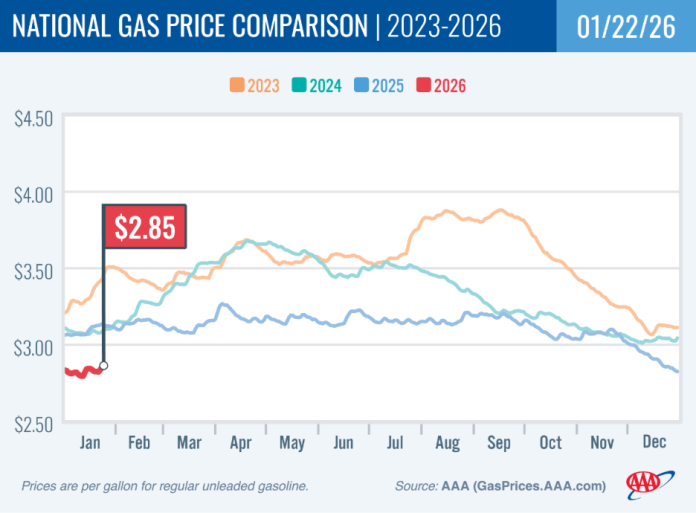
Gas prices have settled into a low plateau during what many consider the slowest driving season of the year. With national averages resting at $2.85 per gallon, small business owners relying on transportation and logistics may find a silver lining in the current market dynamics.
Driving demand is typically at its lowest during January, as winter weather keeps many drivers off the roads. As a result, the price of crude oil is relatively stable, fluctuating between the high $50s and low $60s. With fewer drivers fueling up, the overall market stabilizes, providing an opportunity for some businesses to optimize their budgeting and expense planning.
Over the past week, the national average has seen only a slight increase from $2.844 to $2.850, and it remains significantly lower than the $3.129 average of the same time last year. For small businesses that rely heavily on fuel—like delivery services, transportation firms, and even companies with mobile workforces—this presents a crucial time to reassess fuel allocation and potentially lock in savings.
According to the latest data from the Energy Information Administration (EIA), gasoline demand has dropped from 8.30 million barrels per day to 7.83 million, and domestic gasoline supply has increased from 251 million barrels to 257 million. This decrease in demand combined with growing supply keeps prices in check and may allow businesses to better manage their transportation costs.
For example, a delivery service might analyze their routes and minimize unnecessary trips during this slow period, optimizing their fuel usage and saving costs in the long run. However, as demand will begin to ramp up towards the end of February and early March, businesses should be prepared for potential price changes as more travelers emerge for Spring Break trips.
The oil market has also seen shifts, with West Texas Intermediate (WTI) crude oil settling at $60.62 a barrel, up 26 cents from earlier trading sessions. With crude oil inventories reported at 426 million barrels—about 2% below the five-year average for this time of year—businesses should keep an eye on these trends as they may signal upcoming fluctuations in gasoline prices as demand picks up.
One emerging consideration is the growing electric vehicle (EV) landscape. The national average for charging at public EV stations remains steady at 38 cents per kilowatt hour. For small businesses contemplating the transition to electric fleets, this pricing could have implications on operational costs. States like Wyoming and Kansas boast the cheapest charging rates, making them attractive to businesses that are looking to adopt more sustainable practices without breaking the bank.
On the state level, small business owners should be aware of the disparities in gasoline prices. For example, Oklahoma leads the nation with the least expensive gasoline at $2.38 per gallon, while Hawaii tops the list of most expensive markets at $4.41. Understanding these variances can help business owners strategize when planning trips across state lines or negotiating contracts for delivery services.
Although current conditions favor small businesses in terms of transportation costs, there are challenges ahead. As demand increases, we could see prices rise again toward summer. Therefore, businesses should prepare to adjust their fuel budgets accordingly. This may include evaluating vendor contracts, finding local suppliers with competitive rates, or even exploring alternatives like bulk purchasing to manage expenses more effectively.
With a slightly declining trend in prices and increased supply, now is a strategic time for small businesses to capitalize on these conditions. They can hedge against future fluctuations by optimizing their operations and fuel management practices while keeping an eye on the evolving landscape of gasoline and electric vehicle charging markets.
For more detailed information on current gas prices and charging rates, you can visit the AAA TripTik Travel planner here.
Image Via Gas Price