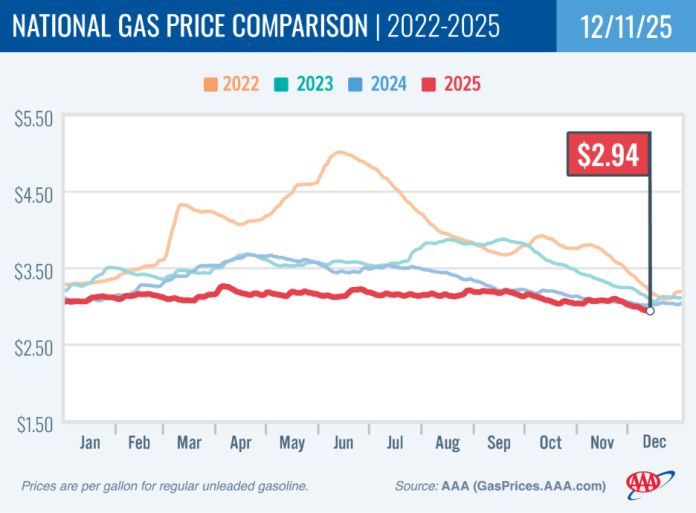
As the holiday season approaches, a welcome trend emerges for American motorists: gas prices are on the decline, enticing an expected record number of travelers to take to the roads. According to the American Automobile Association (AAA), the national average for a gallon of gasoline has dropped to $2.94—5 cents lower than just a week ago and the lowest in four years. This decrease comes at a crucial time as holiday travel ramps up, providing economic relief for small business owners and families alike.
Historically, gas prices tend to surge around this time, but this year’s average sits well below last year’s festive benchmark of $3.04. Such a drop could influence not just individual budgets but also overall spending behavior during the holidays. With numerous seasonal promotions and sales happening, the potential for increased foot traffic at local shops and eateries is on the rise.
“The holiday season should be financially easier for both consumers and small businesses, thanks to lower gas prices,” noted a representative from AAA. “Last year, prices were significantly higher, which likely held back some holiday spending.”
Data from the Energy Information Administration (EIA) indicates a slight uptick in gasoline demand—from 8.32 million barrels per day last week to 8.45 million. Despite a decrease in gasoline production, which averaged 9.6 million barrels per day, the total domestic gasoline supply increased from 214.4 million barrels to 220.8 million. This balance of supply and demand is critical for stabilizing prices as more drivers plan long trips during the holiday season.
Gas prices vary significantly across the country, with states like Hawaii and California seeing averages of $4.44 and $4.41 respectively, while states like Oklahoma and Texas boast much lower rates at $2.36 and $2.51. For small business owners, these regional differences can impact local tourism and spending. Areas with lower gas prices might attract more travelers, thereby boosting local businesses that thrive on seasonal tourism.
While many will experience savings at the pump, small business owners still face pressing decisions. The EIA reported a decrease in crude oil inventories, which could signal future price fluctuations. Watching these trends is crucial for businesses reliant on transportation, from delivery services to those in the hospitality sector. High operating costs due to fluctuating fuel prices could eat into profit margins, making it essential for owners to plan their budgets accordingly.
On the electric side, the national average per kilowatt-hour at public EV charging stations remains at 38 cents. Although these prices are stable, small business owners interested in investing in electric vehicle infrastructure should keep an eye on regional cost variations. States like West Virginia and Alaska report charging costs of 51 and 48 cents respectively, while Kansas and Wyoming offer much lower rates at 26 cents per kilowatt-hour. As more consumers lean towards electric vehicles, understanding local market dynamics can provide a competitive edge for businesses looking to attract eco-conscious customers.
In light of evolving fuel prices and traveler demand, there are practical avenues for small businesses to leverage this seasonal momentum. Offering promotions tied to lower travel costs can attract more customers. Furthermore, businesses can use tools like the AAA TripTik Travel planner to inform customers about gas and charging station prices along their routes, enhancing their travel experience.
As consumers begin to fill up their tanks in preparation for holiday road trips, small businesses across America will undoubtedly feel the effects of this drop in transport costs. This season represents not only a chance to drive sales but also to engage with customers seeking deals and unforgettable experiences.
With considerations of fuel pricing, state-specific dynamics, and strategic business decisions, small business owners have the opportunity to navigate this festive season with an informed and proactive approach.
For more details, you can refer to the original announcement from AAA here.
Image Via Gas Price