Sales and service teams often find themselves mired in a sea of digital tools, juggling between team chats, customer relationship management (CRM) systems, and various productivity apps. This constant switching not only eats away at productivity but also complicates the context needed to close deals and resolve customer inquiries. Recognizing this challenge, Salesforce has unveiled an innovative solution with the integration of Slack as a unified AI work platform, aimed at streamlining workflow for its users.
Starting this summer, every new Salesforce customer will automatically receive a free Slack workspace, seamlessly linked to their CRM data the moment their Salesforce instance is created. No additional setup or costs are involved, allowing teams to dive directly into collaboration with all their relevant data at hand. This integrated approach aims to significantly reduce the time wasted on hunting for information across different platforms.
“Every dollar a company has invested in Salesforce is more valuable when Slack is in the equation,” said Rob Seaman, EVP and GM of Slack at Salesforce. This statement underscores the potential of this integration to enhance existing business processes and workflow efficiency.
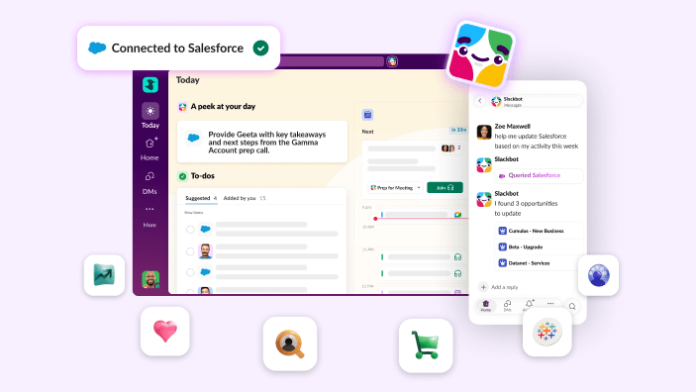
One of the most exciting features is Slackbot, an AI-driven assistant that brings Salesforce data directly into the conversation. Slackbot can execute a myriad of tasks—from logging calls and updating opportunities to managing emails and calendar invites—all within Slack. This means that employees can carry out their daily work without the need to switch between tabs, effectively creating a more streamlined environment.
The new functionality includes a “Today” view, designed to help users focus on what matters most by surfacing priority messages, calendar events, and action items from Salesforce. This curates a tailored daily briefing, making it easier to prioritize tasks ahead of day-to-day distractions. Early adopters like Xero and Wayfair report that AI-suggested action items are not only timely but also highly accurate, hitting effectiveness rates of 88% for actionable messages.
However, small business owners should be aware of challenges that come with this technological shift. While the integration promises significant time savings and improved focus—up to 20 hours a week by some estimates—there may be a learning curve for teams transitioning to this new ecosystem. Organizations that rely on multiple tools may need to invest in training to maximize the platform’s capabilities and ensure that employees feel comfortable utilizing all available features.
The network effect of connecting Slack with Salesforce cannot be understated. The collaborative capabilities are designed to enable timely discussions around sales strategies and customer service scenarios, thereby ensuring that all decisions are grounded in accurate data. Bobby Hollis, Director of Sales Transformation at Motive, noted the transformative impact this integration has had, stating that their quote-to-order process has accelerated from hours to mere minutes.
As Slack integrates with various tools, including Box and different CRM applications, the platform strives to create what has long been dubbed the "single pane of glass." This means employees can complete up to 80% of their tasks without needing to switch applications, which not only enhances productivity but also provides a clearer overview of ongoing projects and communications.
For businesses that may already be entrenched in Salesforce, the setup process for Slack remains straightforward. No disruptions to existing permissions are expected; Salesforce data will remain secure within its existing framework while benefiting from Slack’s streamlined capabilities.
As Slackbot continues to evolve—introducing features like the ability to summarize extensive documents and manage workflows—the potential for productivity enhancement only increases. According to Adrian Rosenkranz, Chief Revenue Officer at Webflow, “A single prompt can pull live blockers from a channel, check against our Salesforce data, and help us move in seconds,” highlighting the operational efficiency gained through this integration.
The collective enthusiasm for this initiative may signal a shift in how small businesses operate and collaborate on a daily basis. By consolidating their tools and data in one accessible space, companies can avoid the pitfalls of fragmented communication and inefficient workflow.
Overall, the ability for every Salesforce customer to start using Slack without extra costs or complicated setups represents a significant opportunity for small businesses. While there are challenges to navigate, particularly around adaptation and learning, the potential for enhanced productivity and better data utilization offers compelling reasons to explore this new platform. For further details, visit the original announcement at Salesforce’s website: Salesforce Press Release.
Image Via Salesforce