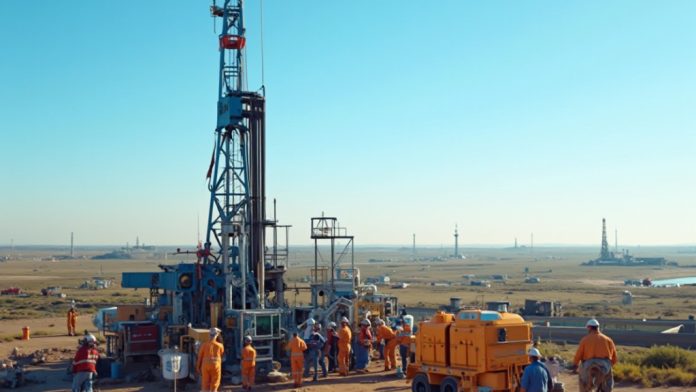
U.S. crude oil production reached unprecedented levels in 2025, offering significant implications for small businesses in various sectors, especially manufacturing and logistics. The U.S. Energy Information Administration (EIA) reported a 3% surge in production, translating to an impressive 350,000 barrels per day (b/d), culminating in a record output of 13.6 million b/d. As small business owners navigate the complexities of rising production, understanding these developments can unlock strategic opportunities.
The bulk of this growth originated from the Lower 48 states, excluding the Gulf of Mexico, which accounted for 11.3 million b/d, or 83% of total U.S. crude oil production. Prominent regions like the Permian Basin, Eagle Ford, and Bakken contributed significantly, highlighting the evolving landscape of domestic oil resources. The Permian Basin alone represented a striking 48% of the overall production, underlining its dominance in the industry.
In 2025, despite a decrease in active rigs—down by 5% compared to the previous year—impressive efficiency gains fueled production increases. Newly drilled wells yielded 2.9 million b/d, while existing wells continued to deliver 8.3 million b/d. Interestingly, a decline in West Texas Intermediate (WTI) crude oil prices from $77 to $65 per barrel motivated this cautious approach. This scenario poses a potential challenge for small business owners as fluctuating oil prices can directly impact operational costs.
As companies in sectors reliant on oil—such as transportation, warehousing, and manufacturing—monitor these shifts, understanding regional performance becomes essential. The Eagle Ford and Bakken regions retained stable production levels, contributing 9% each to U.S. totals. However, the Eagle Ford experienced a marginal rise of 1.6%, while production in the Bakken declined. For small business owners engaged in supply chain logistics, these shifts could affect sourcing decisions and transportation costs going forward.
Production in the Gulf of Mexico also saw notable growth, with a 111,000 b/d increase, averaging 1.9 million b/d for the year. The commissioning of five new offshore projects—Whale, Ballymore, Dover, Shenandoah, and Leon-Castile—signifies a robust commitment to expanding domestic capabilities. This increase showcases potential stability in supply and may encourage small businesses to explore local sourcing strategies, reducing dependency on imported fuels and benefiting from potentially lower prices.
“Efficient production techniques and advancements in technology are key to sustaining growth in these fluctuating markets,” said Naser Ameen, a principal contributor to the EIA report. This sentiment rings particularly true for small businesses aspiring to adopt more efficient practices that can cushion against market volatility.
Despite the promising outlook, small business owners should remain vigilant. The ongoing fluctuation in oil prices, influenced by global events and national policy, could present operational challenges. For those in construction or manufacturing, for instance, a sudden spike in fuel costs can quickly impact profitability. Understanding breakeven points, particularly in regions like the Midland Basin and Delaware Basin, which reported breakeven prices of $61/b and $62/b respectively, is crucial for strategic planning.
Integration of energy efficiency practices will be paramount for small businesses looking to navigate these developments effectively. Many in the manufacturing sector may consider investing in energy-efficient machinery or alternative energy sources as a hedge against oil price volatility.
As the domestic crude oil landscape continues to evolve, the intersection of production growth, energy efficiency, and pricing dynamics will dominate discussions among small business owners. The quest for sustainability, paired with understanding market conditions, remains central as they seek to harness opportunities stemming from these developments in the oil sector.
For deeper insights, business owners can refer to the original analysis from the U.S. Energy Information Administration here: EIA Short-Term Energy Outlook.
Image Via BizSugar