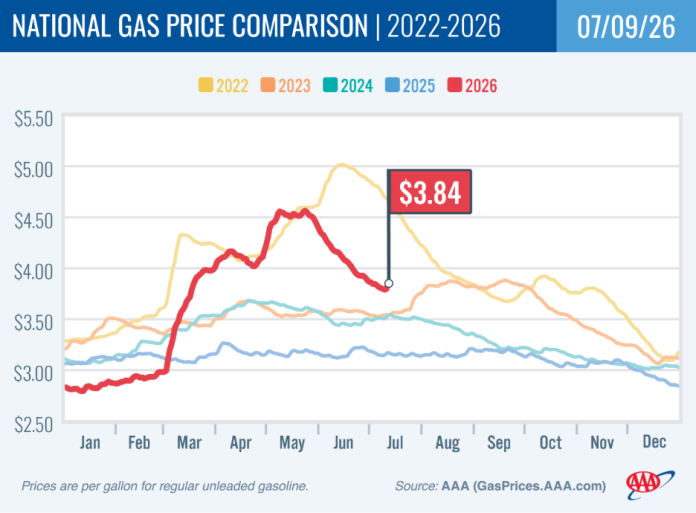
Gas prices are climbing once again, sending ripples through the wallets of small business owners across the nation. As of July 9, 2026, the national average price for a gallon of regular gasoline stands at $3.84, a 5-cent increase from the previous day, reversing a trend of steady decline since late May. For business owners reliant on transportation and logistics, these fluctuations could have serious implications for costs.
Crude oil prices remain volatile, hovering around $70 per barrel, with potential to increase further amidst ongoing uncertainties in the Strait of Hormuz. This region is crucial to global oil supply, and any shifts could affect fuel prices well into the future. While current prices are notably lower than the spring peak of $4.56 per gallon, small businesses should brace for impact as the market evolves.
Recent data from the Energy Information Administration (EIA) indicates that gasoline demand dropped significantly last week, declining from 9.13 million barrels per day (b/d) to 8.84 million. With domestic gasoline supply also dipping, decreasing from 214 million barrels to 212.1 million, small business owners may want to consider adjusting their fuel budgeting strategies.
Gasoline production has also decreased to an average of 9.7 million barrels per day, further complicating the landscape for businesses that depend heavily on fuel. According to the EIA, U.S. crude oil inventories are currently about 6% below the five-year average. This scenario could lead to increased prices if demand rebounds or supply constricts further.
For small businesses with fleets, the implications of rising gas prices extend beyond the fuel gauge. Transportation costs typically figure into broader operational expenses, and fluctuating fuel prices can strain margins. Businesses operating in regions like Hawaii, California, and Washington—where prices exceed $4.99 per gallon—may face particularly challenging financial landscapes.
Quotes from industry analysts indicate the urgency for small business owners to monitor these price changes closely. “With rising costs, it’s crucial to reassess supply chains and fuel-efficient practices,” says an analyst from the EIA. “Navigating these fluctuations proactively can make a substantial difference.”
In the realm of electric vehicle (EV) charging, the national average price per kilowatt hour has also seen a slight increase, now at 42 cents. The gap in pricing between gasoline and electric charging could sway businesses considering fleet transitions toward electric alternatives. Charging costs vary widely across states; Kansas offers the most affordable rates at 30 cents per kilowatt hour, contrasting sharply with prices in states like West Virginia and Hawaii, where costs soar to 53 and 51 cents, respectively.
As small business owners weigh their fuel options, the decision to invest in EVs or adapt existing fleet logistics may be driven not just by environmental concerns but also financial realities. With rising gas prices expected to deploy ripples of impact across various sectors, reevaluating transportation options may soon become a necessity.
The current energy landscape highlights regional disparities in fuel pricing. While Indiana, Oklahoma, and Texas currently boast some of the least expensive gas markets—averaging prices around $3.21 to $3.41—businesses in areas with higher costs may have to consider their supply chain management and operational logistics more carefully.
Moreover, as more businesses adapt to changing energy dynamics, monitoring platforms, like the AAA TripTik Travel planner, provide real-time insights into gas and electric charging prices. Staying informed could empower small businesses to make decisions that optimize their logistics and commuter expenses.
As gas prices show signs of upward movement amid complex geopolitical issues and local supply-demand dynamics, small business owners would do well to remain agile. Adjusting operational strategies and exploring alternative fuel options could be critical as the landscape continues to evolve.
For further details, visit the original press release here.
Image Via Gas Price