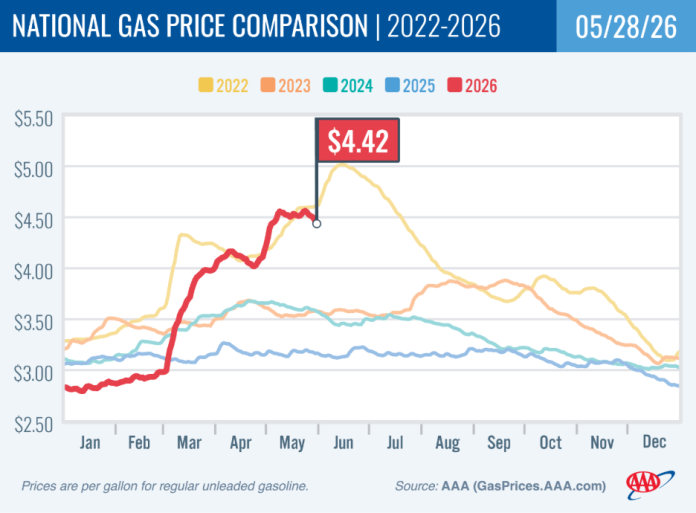
Gas prices across the U.S. have started to decline, providing a glimmer of hope for small business owners who are feeling the pinch of rising operational costs. The national average for a gallon of regular gasoline has dropped by 12 cents over the past week, now sitting at $4.42. While this decrease is welcome news, the ongoing geopolitical climate—specifically fluctuating crude oil prices due to potential peace negotiations with Iran—could lead to further volatility.
This reduction in gas prices is particularly significant for small business owners dependent on transportation for deliveries or service calls. Many have struggled over the past year as prices surged, climbing from $3.16 a year ago to well over $4 in recent months. With the onset of the summer driving season, any relief can aid in stabilizing budgets and preserving profit margins.
“As we transition into summer, we typically see an uptick in gas demand, which can put pressure on prices,” noted an industry expert. “However, the recent decline offers some breathing room for businesses reliant on gasoline.”
In recent weeks, gasoline demand increased from 8.76 million barrels per day (b/d) to 9.25 million b/d, as reported by the Energy Information Administration (EIA). This uptick, alongside a decrease in total domestic gasoline supply—from 214.2 million barrels to 211.6 million barrels—has the potential to affect future price stability.
Crude oil price dynamics also play a crucial role in this scenario. West Texas Intermediate (WTI) crude settled at $88.68 a barrel, down $5.21 in just one trading session. Though current stocks of U.S. crude oil are about 2% below the five-year average, a potential ceasefire in Iran could cause prices to rise again.
For small businesses, especially those in industries such as delivery services, logistics, or fieldwork, these fluctuations present both opportunities and challenges. On one hand, a drop in fuel prices may lead to reduced transportation costs, allowing businesses to reevaluate pricing strategies or invest in services. On the other, the unpredictability of future price spikes means that budget forecasting must remain flexible. Businesses should prepare for possible scenarios that could increase operational expenditures should crude oil prices surge again.
Moreover, the cost of electricity for electric vehicle (EV) charging stations has stabilized at 41 cents per kilowatt-hour. As more businesses consider transitioning to electric vehicles to cut costs, understanding the regional differences in charging rates can be invaluable. For instance, the states with the highest public charging costs include West Virginia and Hawaii, while Kansas offers the most economical rates.
Small business owners might find value in monitoring both gas and electric vehicle charging prices. This could influence decisions on fleet management, especially in regions experiencing stark price variations. Using tools like the AAA TripTik Travel planner can assist businesses in locating the best prices for gas and charging along their routes, enhancing efficiency.
As small business owners look ahead, understanding market trends and price fluctuations becomes increasingly important. With summer just around the corner, managing transportation costs effectively will be key to maintaining competitiveness.
It is crucial for small business owners to remain adaptable. While the recent decline in gas prices offers some temporary relief, considering fuel price volatility—spurred by geopolitical events—will be necessary to navigate the operational landscape effectively. Keeping a keen eye on these trends can prepare businesses for whichever direction prices may head.
For updated information on gas prices and broader market trends, you can visit the original source here.
Image Via Gas Price