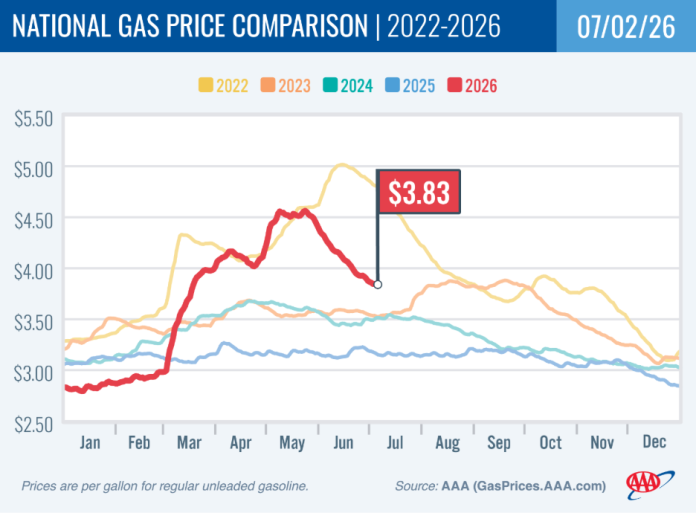
As millions of Americans prepare for the long Independence Day weekend, many are finding some relief at the fuel pump. The national average price of regular gasoline has dropped nearly 50 cents over the past month, currently standing at $3.83 per gallon, according to the latest data from AAA. While this figure is higher than last year’s average of $3.17, it represents a significant decline from the spring peak of $4.56 recorded on May 21, 2026.
Crude oil prices have also seen a marked decrease, falling to around $60 per barrel. Although gas prices are still the highest they’ve been in four years, the trend of decreasing prices since late May is particularly welcome during the summer driving season, which often sees increased travel and consumer spending.
Small business owners, particularly those involved in the transportation, travel, and retail sectors, should take note of these fluctuations. Lower gas prices can enhance consumer spending as drivers feel more inclined to travel, which can directly benefit local businesses that rely on foot traffic and sales tied to tourism.
According to recent data from the Energy Information Administration (EIA), gasoline demand has surged from an average of 8.77 million barrels per day to 9.13 million, while total domestic gasoline supply has edged down from 216.3 million barrels to 214 million. This uptick in demand accompanies a rise in gasoline production, which is now averaging 10 million barrels per day.
Oil market dynamics also play a crucial role in pricing trends. Recently, West Texas Intermediate (WTI) crude oil saw a decrease of 92 cents, settling at $68.58 per barrel. Current crude oil inventories are about 7% lower than the five-year average for this time of year, indicating potential volatility in the market that small business owners may need to account for in financial planning.
For those looking to pivot towards electric vehicles (EVs), the national average per kilowatt-hour for public EV charging stations remains stable at 41 cents. This aspect can be vital for small business owners considering the integration of EVs into their fleet or services, especially as more consumers turn to electric transportation options.
While gas prices may be lower now, they still vary significantly by state. For example, Hawaii leads the most expensive markets with an average price of $5.48, while Indiana boasts one of the lowest averages at $3.12. Small businesses should keep these regional differences in mind, as transportation costs can directly influence operational budgets and pricing strategies.
Additionally, states with higher costs for EV charging, such as West Virginia and Hawaii, may face challenges in transitioning customers to electric vehicles. Conversely, states like Kansas and Missouri offer more competitive rates, which could encourage small business owners in those areas to invest in EV infrastructure.
"Gasoline prices may still be elevated year-over-year, but any downward trend can help keep consumer sentiment positive," said an industry expert. For small businesses, understanding consumer behavior during these changes is crucial. Whether the aim is to increase foot traffic through special promotions or adjust pricing strategies to account for fluctuating fuel costs, there are actionable insights to be gained.
With potential challenges ahead, such as fluctuating fuel prices and varying demand based on regional factors, business owners are urged to stay informed. Utilizing resources such as the AAA TripTik Travel Planner can help identify current gas and electric charging prices along routes, enabling businesses to plan more effectively.
As we move into the bustling summer months, the positive news on gas prices offers both opportunities and challenges for small businesses. Understanding and adapting to these dynamics can help local retailers and service providers not only survive but thrive.
For further details on current fuel prices and trends, businesses can refer to the original AAA press release here.
Image Via Gas Price