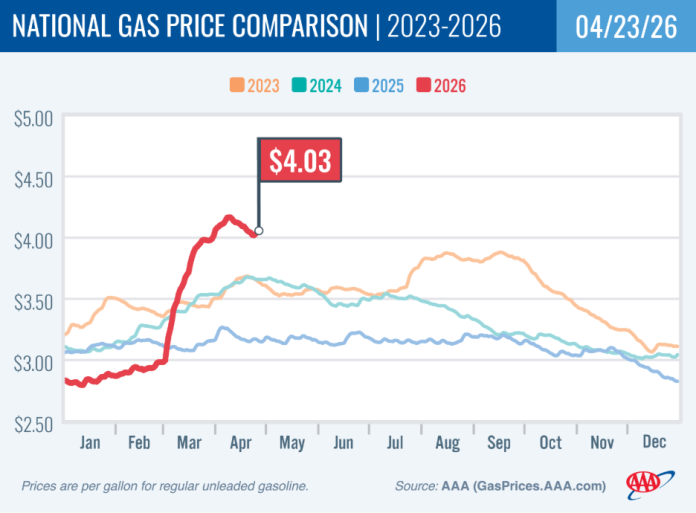
Drivers across the nation are breathing a sigh of relief as they see the national average gas price dip slightly to $4.03 per gallon, a decrease of 6 cents compared to last week. The downward shift comes amid falling crude oil prices, which have now settled below $100 per barrel, easing some of the financial pressures on consumers. However, with geopolitical tensions, particularly around the Strait of Hormuz, the sustainability of this drop remains uncertain.
The current national average is reminiscent of previous years, with pump prices being the highest this time since 2022. A look back reveals that gas prices were slightly higher last year, at $4.11 per gallon on the same date. Although this week shows a modest decrease, drivers may still feel the pinch compared to a year ago when prices were significantly lower at $3.17.
Current statistics from the Energy Information Administration (EIA) indicate a slight dip in gasoline demand, dropping from 9.08 million barrels per day (b/d) to 9.05 million b/d. Concurrently, the supply of gasoline also decreased from 232.9 million barrels to 228.4 million. On a positive note, gasoline production increased, averaging 10.1 million barrels per day, providing hope that supply could stabilize prices moving forward.
For small business owners, particularly those in logistics or delivery sectors, fluctuating gas prices can significantly impact operating costs. Keeping tabs on gas price trends may allow businesses to adapt budgets accordingly and strategize their operations effectively. As driving costs rise or fall, owners may also want to consider implementing fuel-efficient practices or exploring alternative energy options, such as the increasing availability of electric vehicles.
At the close of Wednesday’s trading session, West Texas Intermediate (WTI) crude oil saw a price increase, closing at $92.96 per barrel. This uptick comes in light of increased crude oil inventories, which have risen by 1.9 million barrels from the prior week. Currently, U.S. crude oil inventories stand at 465.7 million barrels, exceeding the five-year average for this season by about three percent.
Interestingly, the realm of electric vehicles (EVs) shows some positive news as well. The average price per kilowatt hour at public charging stations has dipped by one cent to 40 cents. This decrease could encourage more consumers to consider EVs as a cost-effective alternative, particularly as gas prices fluctuate. Business owners who are contemplating making the switch to electric fleets might find this a timely opportunity to invest.
Regionally, gas prices vary significantly, with California leading as the most expensive market at an eye-watering $5.84 per gallon. Others following closely include Hawaii ($5.65) and Washington ($5.39). In stark contrast, Oklahoma boasts the lowest prices at $3.40 per gallon, illustrating the disparities that exist across the country. Such variations can be crucial information for businesses operating across multiple states or those with delivery services affecting their bottom line.
The same goes for electric charging costs; states like West Virginia and Hawaii are among the most expensive for public charging, with rates hitting 53 cents and 51 cents, respectively. Meanwhile, Kansas tops the list of least expensive states at just 25 cents per kilowatt hour. For small business owners investing in EV infrastructure, understanding regional charging costs could yield significant savings and facilitate smarter planning.
Business owners are encouraged to utilize tools like the AAA TripTik Travel Planner to monitor current gas and electric charging prices along their routes, providing up-to-date information helpful in making cost-effective decisions.
As gas prices display minor relief, the economic landscape for transportation remains turbulent. Small business owners should remain vigilant, adapt to ongoing developments, and utilize available data to navigate the complexities of fuel costs effectively. The market’s future may be uncertain, but informed decisions can lead to beneficial adaptations in these shifting conditions.
To view the original press release, visit: AAA Gas Prices.
Image Via Gas Price