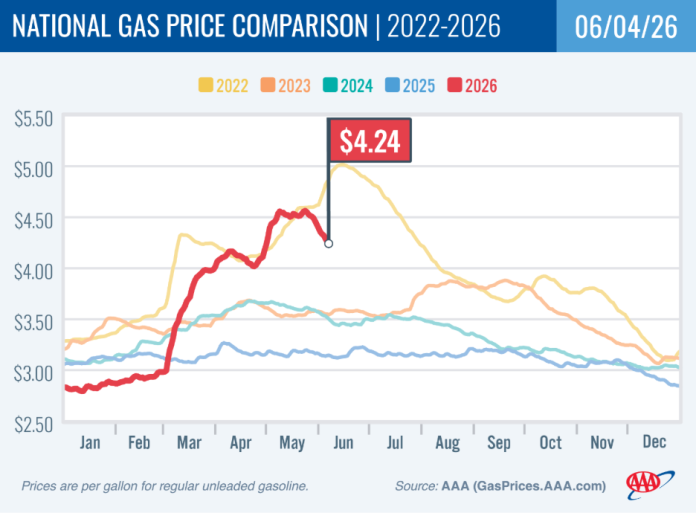
As summer approaches, gas prices are taking a welcome dip, offering relief for small business owners who depend on their vehicles for daily operations. The national average price of a gallon of regular gasoline has dropped by 18 cents in just one week, now sitting at $4.24. This marks the second consecutive week of declining prices, a trend particularly beneficial for small businesses with transportation needs.
With road trips on the rise, particularly in the wake of a two-week price drop, drivers will indeed welcome this cost reduction. However, caution is warranted as uncertainties linger regarding global oil supply, particularly concerning the Strait of Hormuz. It remains unclear when this vital shipping lane will fully reopen, which could influence future pricing as demand increases during the summer season.
Recent data from the Energy Information Administration (EIA) paints an insightful picture of the current gasoline landscape. While gasoline demand dipped from 9.25 million barrels per day to 8.59 million, an increase in total domestic gasoline supply—from 211.6 million barrels to 215 million—has helped stabilize prices. However, production has seen a decrease, averaging 9.4 million barrels per day last week, suggesting potential constraints ahead.
"Current trends give us some breathing room, but the broader oil market dynamics continue to be unpredictable," said an EIA spokesperson. This instability may pose challenges for small businesses reliant on fuel for deliveries or client visits, especially as production rates fluctuate.
The recent stabilization in gasoline prices is juxtaposed against the current state of crude oil, which closed at $96.02 per barrel after rising $2.26. Meanwhile, U.S. crude oil inventory levels have decreased by 8 million barrels compared to the prior week, landing at a total of 433.7 million barrels—approximately 3 percent below the five-year average for this time of year. As the summer heat brings on increased gasoline demand, these dynamics could influence prices notably.
For businesses exploring alternative energy solutions, the electricity rate for public electric vehicle (EV) charging has remained constant at 41 cents per kilowatt hour. EV adoption is increasing among small businesses aiming to lower their carbon footprints, and stable charging costs can contribute to predictable operating expenses.
In examining state-level gas prices, disparities are evident. For instance, California leads with the highest average at $5.97 per gallon, followed closely by Washington at $5.66. On the flip side, states like Indiana and Texas offer some of the lowest prices, at $3.55 and $3.72, respectively. This variation can significantly affect regional businesses and their operational costs, emphasizing the importance of local market analyses for small business owners.
Further, state-level data also highlights differences in public EV charging rates, with states like Kansas offering charging at just 30 cents per kilowatt hour, while West Virginia sees rates as high as 53 cents. As businesses consider transitioning to electric fleets, understanding these regional variations will be crucial.
Drivers, whether for business or leisure, can quickly find up-to-date gas and electric charging prices along their routes using tools like the AAA TripTik Travel Planner. Staying informed can help small businesses manage transportation costs more effectively.
As gas prices continue to fluctuate, small business owners should remain vigilant and adaptable. Keeping an eye on market trends, understanding local price disparities, and considering alternative energy solutions can lead to more informed decisions that benefit both the bottom line and sustainability goals.
For more detailed information on current gas prices, visit the AAA website here: AAA Gas Prices.
Image Via Gas Price