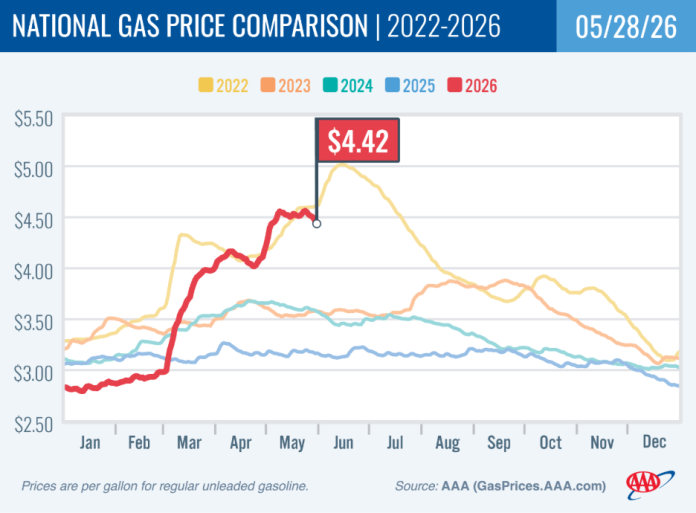
Gas prices are experiencing a notable dip, with the national average dropping to $4.42 per gallon—a decrease of 12 cents from the previous week. This decline comes at a time when small businesses are closely monitoring fuel costs, particularly as the bustling summer driving season approaches. The current situation presents both advantages and potential hurdles for entrepreneurs navigating the impacts of fluctuating gasoline prices.
Increased gasoline demand, as reported by the Energy Information Administration (EIA), shows a significant rise from 8.76 million barrels per day to 9.25 million. However, total domestic gasoline supply has decreased from 214.2 million barrels to 211.6 million, signaling tighter supply amid rising demand. As fuel is a critical expense for many businesses, especially those dependent on transportation, this development could affect operational costs and pricing strategies.
“Gasoline production has increased, averaging 9.9 million barrels per day, which helps to mitigate supply issues,” said a spokesperson from EIA. Nevertheless, the shadow of international dynamics looms large—especially peace talks with Iran—that could alter crude oil prices dramatically depending on the outcomes.
For business owners, the implications are clear. While a temporary reduction in fuel prices may ease immediate financial pressures, the overall trend remains volatile. The national average for gasoline has historically fluctuated, and prices are notably higher than they were this time last year when gas was approximately $3.16 per gallon. Small business owners should prepare strategies that can adapt to sudden changes in fuel expenses.
Analyzing further, the recent drop in West Texas Intermediate (WTI) crude oil pushed prices down to $88.68 per barrel, a decline prompted by a report indicating a 3.3 million barrel decrease in U.S. crude oil inventories compared to the previous week. Inventory levels are currently about 2% below the five-year average for this period, emphasizing a market still under strain.
Also worth noting is the fixed rate for public electric vehicle (EV) charging, which has remained steady at 41 cents per kilowatt-hour. For businesses considering transitioning to electric vehicles as a cost-saving measure, evaluating charging costs becomes crucial. Understanding regional pricing differences can influence decisions on fleet management and operational expenses.
State-by-state analyses reveal a significant disparity in gasoline prices across the U.S. California leads the country with exorbitant rates around $6.07 per gallon, while states like Indiana and Texas boast far more favorable prices at approximately $3.81 and $3.92, respectively. This information could be particularly beneficial for small business owners evaluating logistics and distribution tasks across state lines.
As businesses face the dual challenge of navigating their fuel requirements while also considering the evolving EV landscape, understanding local pricing variability will be key. The EIA’s findings also underscore potential growth in EV adoption, as transportation costs are critical to profitability, making it worthwhile for businesses to invest in electric fleet options where feasible.
In practical terms, small business owners can leverage tools such as the AAA TripTik Travel Planner to monitor current gas and electric charging prices along their routes. This type of resource can inform route planning and optimize fuel efficiency—a vital aspect of managing operational costs effectively, especially for delivery-based services.
In summary, while small business owners may find temporary relief from gas prices heading into summer, the larger market dynamics suggest a complex landscape ahead. Preparing for potential spikes in fuel costs, exploring electric vehicle options, and utilizing resources for real-time price tracking could position them favorably in this uncertain environment. As always, keeping a keen eye on both supply chain and operational efficiencies will remain paramount.
For further details, you can view the original press release here.
Image Via Gas Price