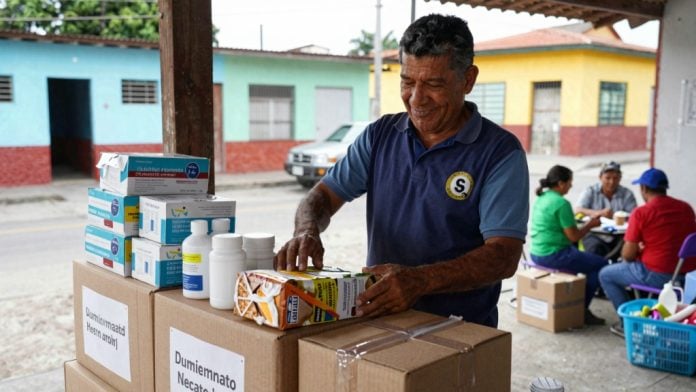
In a groundbreaking initiative, Amazon has announced its support for a humanitarian air delivery operation to Venezuela, following devastating earthquakes that impacted over 650,000 people in the region. The collaboration involves a weekly deployment of seven flights to Caracas, bringing much-needed aid directly to the communities in need. This innovative approach not only highlights Amazon’s commitment to social responsibility but also showcases the potential for businesses to engage in humanitarian efforts effectively.
The initiative is made possible through a unique partnership among Amazon, Airlink, the U.S. State Department, and the United Nations World Food Programme (WFP). Amazon is handling logistics by donating aircraft and fuel, while Airlink will determine supplies based on nonprofit needs. The WFP will manage all logistical operations underground. Such a coordinated effort aims to prevent bottlenecks commonly associated with humanitarian aid distribution and ensures that resources reach those who need them quickly.
Bettina Stix, Director of Amazon’s Community Impact, emphasized the urgency of the situation, stating, "When more than 6 million people are affected and entire neighborhoods have been reduced to rubble, getting supplies quickly isn’t just helpful—it’s critical." This statement encapsulates the essence of the partnership, which echoes historical precedents where humanitarian air bridges have met urgent civilian needs, making this a significant milestone for both Amazon and the communities in Venezuela.
Several factors make this operation particularly beneficial for small business owners who might consider their role in humanitarian efforts. For instance, Amazon’s experience in disaster relief—including the donation and delivery of over 26 million supplies in response to more than 200 disasters—serves as a model for how businesses can pivot their expertise towards corporate social responsibility. The company’s capacity for rapid response could inspire smaller organizations to adopt similar initiatives aligned with their brand identities.
The air bridge initiative aims to preempt the phenomenon of "second disasters," where unsolicited donations can overwhelm communities, complicating logistical needs rather than alleviating them. As quoted by Paloma Adams-Allen, Airlink’s President and CEO, "In a disaster of this magnitude, coordination and speed of response is everything." This pragmatic approach could serve as a blueprint for small businesses exploring scalable solutions to contribute to humanitarian efforts without overcrowding local infrastructures.
However, while the benefits of such initiatives are evident, small business owners should also be aware of potential challenges. The scale of operations, as demonstrated by Amazon, may not be feasible for smaller organizations without similar logistical capabilities. Additionally, the alignment of business objectives with charitable endeavors requires careful consideration; failure to do so may result in unintended consequences that could affect brand reputation.
On the ground in Venezuela, the need for assistance is immense. Stephanie Hochstetter, the WFP Country Director, emphasized this by stating that "this air bridge will support the transfer of supplies to communities efficiently through trusted humanitarian channels." The logistics are made more complex by the country’s political and economic challenges, posing hurdles that require thoughtful navigation. Small businesses contemplating involvement in humanitarian aid may need to assess their own capacities and how they can effectively partner with existing organizations to maximize impact.
Amazon’s ongoing commitment extends beyond the air bridge, with the company also providing rapid response technology systems that establish connectivity in affected areas. This aspect of the initiative could inspire smaller businesses to leverage their technological expertise for social good, promoting seamless communication in crisis situations.
With ongoing efforts to adapt to evolving needs, Amazon exemplifies a model of how corporations can act as catalysts for social change. By engaging in initiatives like these, businesses can create a positive impact that resonates not only within the affected communities but also among their customers and stakeholders. As Amazon continues its support for Venezuelan earthquake relief, it stands as a robust case study for small businesses considering how to contribute meaningfully to societal challenges.
For more detailed information on the initiative, check out the original announcement from Amazon here.
Image Via BizSugar