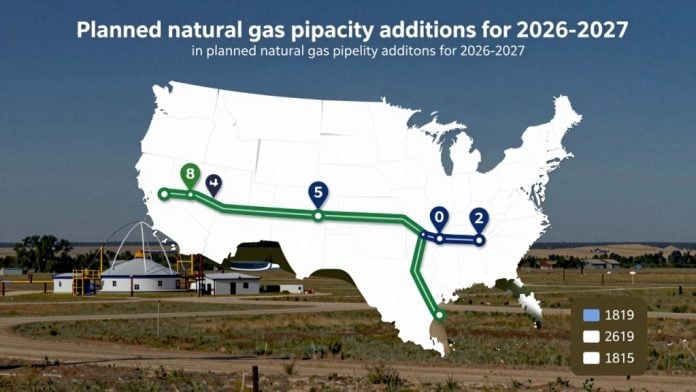
As the U.S. strives to enhance its energy infrastructure, small business owners in the natural gas sector have a significant opportunity on the horizon. According to the latest report from the Energy Information Administration, developers are set to bring approximately 44.9 billion cubic feet per day (Bcf/d) of new natural gas pipeline capacity online between 2026 and 2027. With about 70% of this capacity already under construction, the implications for small businesses are far-reaching.
The heart of this expansion lies primarily in Texas, which will contribute around 31.6 Bcf/d, accounting for over two-thirds of the upcoming capacity additions. Louisiana follows with a promising 8.4 Bcf/d, enhancing its significance in the energy landscape.
One major driver of this increase is the need to improve takeaway capacity from the Permian Basin and streamline operations at the Waha Hub. This development not only bolsters natural gas supply to liquefied natural gas (LNG) export terminals but also supports a variety of residential, industrial, and power generation users.
Key projects to watch include the Rio Bravo Pipeline, a 138-mile route set to deliver feed gas to the NextDecade Rio Grande LNG export terminal. Projected to come online in the latter half of 2026, this pipeline represents a robust new avenue for businesses involved in the LNG export sector. NextDecade’s emphasis on timely execution underscores a growing demand for efficient energy infrastructure.
Additionally, the Blackcomb Pipeline and the Hugh Brinson Project are also noteworthy. The former, a 365-mile pipeline stretching from Texas, is expected to ease the bottleneck at the Waha Hub, while the latter aims to further enhance takeaway capacity from the Permian Basin. These projects are not just technical achievements; they symbolize increased business opportunities in the region.
Small business owners can seize this development in multiple ways. For example, increased pipeline capacity means more reliable access to natural gas supplies. Service providers, equipment manufacturers, and logistics companies can expect heightened demand as larger energy projects accelerate.
Moreover, small businesses specializing in environmental compliance and regulatory navigation could find fertile ground as the energy sector adapts to new pipelines and operational demands. As Ed Wong, a project manager at a leading energy consultancy, stated, "These pipeline expansions will not only reduce delays but also introduce new markets for smaller firms to explore."
However, potential challenges also accompany this expansion. Small business owners must prepare for fluctuations in energy prices and market competition as new capacity comes online. The dynamics of supply and demand could shift significantly, impacting profit margins and prompting a need for strategic planning.
Furthermore, regulatory hurdles can pose risks. As new pipelines are constructed, businesses must remain agile, ensuring compliance with environmental standards and zoning laws. This necessity highlights the importance of robust project management and foresight in business planning.
Finally, technological advancements play a pivotal role in increasing energy efficiency. Small businesses might need to invest in new technologies or systems to keep pace with evolving operational requirements stemming from expanded pipeline capacities. Collaboration with local technical firms can be beneficial in this context.
The anticipated surge in natural gas pipeline capacity presents a promising landscape for small business owners within the energy sector. With proper strategic planning, proactive market engagement, and a keen eye on regulatory changes, small businesses can navigate this dynamic environment effectively and leverage new opportunities as they arise.
For further details, you can view the original report here.
Image Via BizSugar